MQTT Sparkplug B: A Game-Changer for Industrial Messaging
March 15, 2026
MQTT Sparkplug B: A Game-Changer for Industrial Messaging
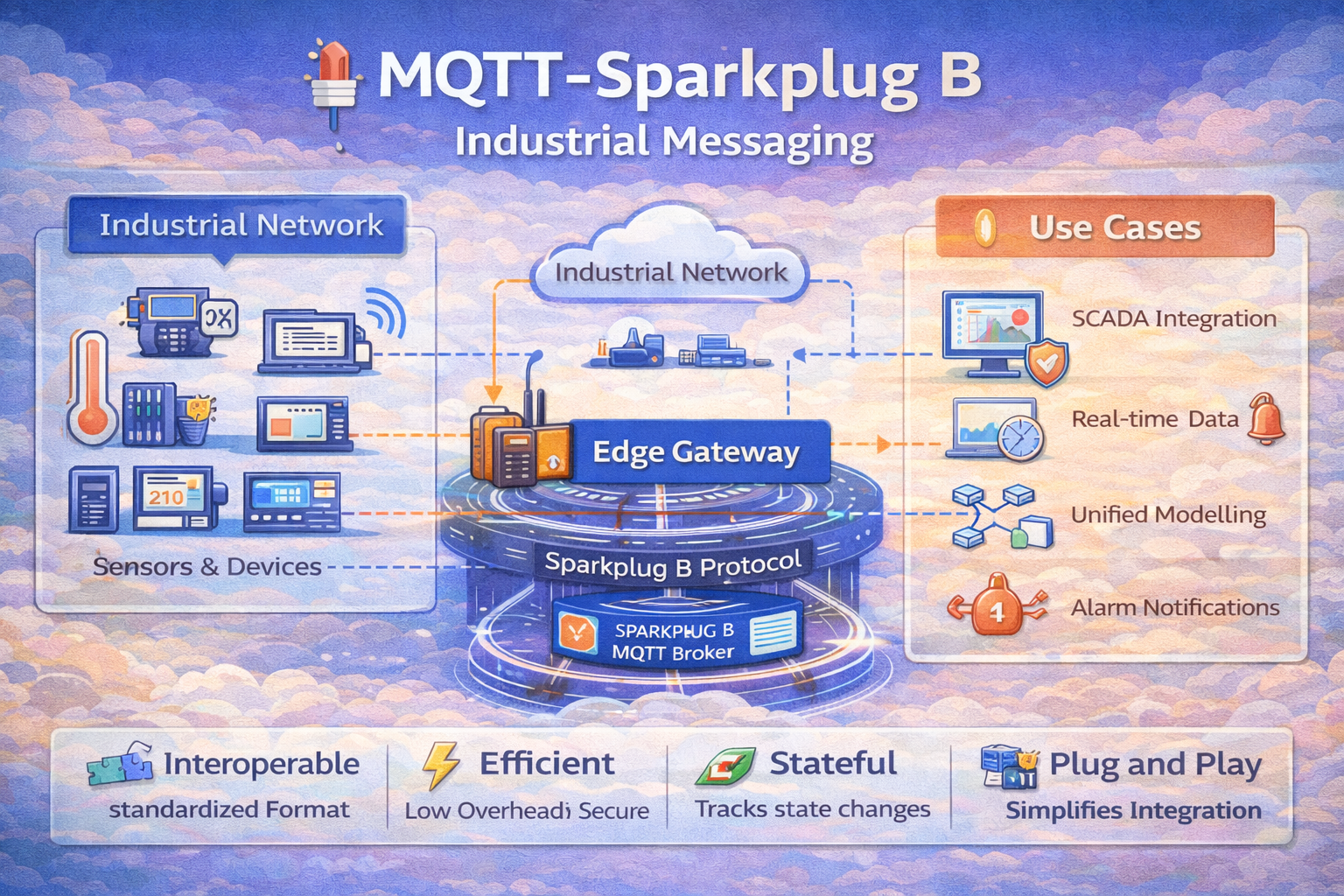
While the MQTT protocol is powerful and lightweight, its core specification is topic and payload agnostic. This can lead to a lack of interoperability in complex industrial systems. Sparkplug B is an open-source software specification that builds on top of MQTT to solve this problem.
The Definitive Guide to MQTT
This article is a part of our comprehensive series on the MQTT protocol. Sparkplug B is a specification that builds on top of MQTT to solve common IIoT challenges. For a complete understanding of the core protocol, please refer to our new Definitive Guide to the MQTT Protocol.
Sparkplug B defines a standardized topic namespace, payload structure, and session state management, making it purpose-built for Industrial IoT (IIoT) and SCADA systems.
The Three Core Problems Sparkplug B Solves
- Lack of Standardization: In plain MQTT, custom parsing is required for every device type.
- Statelessness: A new application connecting to a broker doesn't know which devices are online or their current states.
- Inefficiency: Publishing every data point, even if it hasn't changed, is inefficient.
These are challenges often faced when scaling a generic MQTT implementation in an industrial setting.
Key Components of the Sparkplug B Specification
Sparkplug defines a specific architecture and set of message types to run over a standard MQTT broker.
- SCADA/IIoT Host: The primary application that consumes and commands data.
- Edge of Network (EoN) Node: A gateway or intelligent device that acts as the bridge between legacy devices and the MQTT network. It is the primary data publisher.
Standardized Topic Namespace and Payload
Sparkplug defines a strict topic structure: namespace/group_id/message_type/eon_node_id/[device_id]
The payload is a highly efficient binary format defined by Google Protocol Buffers (Protobuf), which includes a timestamp and a list of "metrics" (the data points).
Stateful Awareness through Birth & Death Certificates
This is the most powerful feature of Sparkplug.
- Birth Certificates (
BIRTH): When a device comes online, it publishes a "birth certificate" message containing a complete list of all its metrics and their current values. The SCADA host application subscribes to these topics and immediately knows the device is online and has a full data image. - Death Certificates (
DEATH): Using MQTT's built-in Last Will and Testament (LWT) feature, a "death certificate" is published automatically if a device disconnects ungracefully. This allows the host to immediately mark all associated data as stale.
By combining stateful awareness with report-by-exception, Sparkplug B provides a robust and interoperable solution for industrial messaging built on the flexible foundation of the MQTT publish-subscribe model.
A Deep Dive into the Sparkplug B Architecture and Concepts
The overview above introduces the core value proposition of Sparkplug. To successfully design, deploy, and troubleshoot a Sparkplug-based IIoT system, a much deeper understanding of its components, message flows, and data structures is required. This section will explore the nuances of the specification, providing a comprehensive guide for architects, engineers, and developers.
The Sparkplug Logical Architecture Explained
The Sparkplug architecture consists of three main logical components:
-
SCADA / IIoT Host Application: This is the central application, often referred to as the Primary Host. It is the main consumer of data from the field and the primary source of commands sent back to the devices. In a typical setup, this would be an application like Ignition SCADA, Canary Historian, or a custom-built enterprise application. A key feature of Sparkplug is that it allows for Non-Primary Hosts to connect simultaneously. These could be applications for analytics, maintenance, or monitoring that can listen to all the data without interfering with the Primary Host's control operations.
-
Edge of Network (EoN) Node: The EoN Node is the intelligent heart of a Sparkplug deployment. It is a piece of software or hardware that acts as a gateway. Its primary responsibilities are:
- Establishing a connection to the MQTT broker.
- Managing the Sparkplug state machine for itself and all attached devices.
- Communicating with downstream devices, which may use legacy protocols like Modbus, Allen-Bradley's EtherNet/IP, or OPC DA.
- Translating the proprietary data from these devices into the standardized Sparkplug metric format.
- Publishing BIRTH, DATA, and DEATH certificates for itself and the devices it manages.
- Subscribing to command topics and translating incoming commands back into the proprietary protocol of the end device.
-
Devices: In the Sparkplug context, a "Device" is a logical representation of a downstream asset connected to an EoN Node. It is not necessarily a physically separate piece of hardware. For example, a single gateway (the EoN Node) might connect to a PLC. That PLC's controller tags could be represented as one Sparkplug Device, and the tags from a VFD connected to that PLC could be represented as a second Sparkplug Device, all managed by the single EoN Node.
The Sparkplug Topic Namespace in Detail
The rigid topic structure is fundamental to Sparkplug's auto-discovery capabilities. Every Sparkplug-compliant application knows exactly where to listen for messages and how to interpret them based on the topic alone.
Let's break down the structure: namespace/group_id/message_type/eon_node_id/[device_id]
-
namespace: This is fixed asspBv1.0for Sparkplug B. It ensures that Sparkplug messages can be clearly distinguished from any other non-Sparkplug MQTT messages that might be on the same broker. -
group_id: This segment logically groups a collection of EoN Nodes. It could represent a physical location (Site_A), a production line (Line_3), or a functional area (HVAC). This allows for efficient filtering of data by host applications. -
message_type: This defines the purpose of the message and is one of the following:NBIRTH: Node Birth Certificate. Published by an EoN Node when it first comes online.NDATA: Node Data. Used for publishing updates to the EoN Node's own metrics.NDEATH: Node Death Certificate. The Last Will and Testament (LWT) of an EoN Node.DBIRTH: Device Birth Certificate. Published by an EoN Node on behalf of a device it manages.DDATA: Device Data. Used for publishing updates to a device's metrics.DDEATH: Device Death Certificate. Published by an EoN Node on behalf of a device.NCMD: Node Command. Used by a host to send commands to the EoN Node itself (e.g., to request a reboot).DCMD: Device Command. Used by a host to send commands to a specific end device (e.g., to change a setpoint).
-
eon_node_id: A unique identifier for the EoN Node within thegroup_id. For example,Gateway_01. -
[device_id]: An optional field used only for device-level messages (DBIRTH,DDATA,DDEATH,DCMD). It uniquely identifies a device managed by theeon_node_id. For example,Boiler_2.
Example Topics:
spBv1.0/Site_A/NBIRTH/Gateway_01: The birth certificate for Gateway_01 at Site_A.spBv1.0/Site_A/DDATA/Gateway_01/Boiler_2: A data update for Boiler_2, which is managed by Gateway_01.spBv1.0/Site_A/DCMD/Gateway_01/Boiler_2: A command being sent to Boiler_2.
The Sparkplug Payload: A Deep Dive into Protobuf and Metrics
While the topic tells you where the data is from, the payload tells you what the data is. Sparkplug mandates the use of Google Protocol Buffers (Protobuf) for payload encoding. This is a deliberate choice over text-based formats like JSON for several critical reasons:
- Efficiency: Protobuf is a binary format. The resulting payloads are significantly smaller and faster to parse than equivalent JSON, which is crucial for bandwidth-constrained networks (like cellular or satellite) common in IIoT.
- Strict Schema: The payload structure is defined in a
.protofile. This acts as a contract, eliminating ambiguity and ensuring that both the publisher and subscriber agree on the data types and structure. - Forward/Backward Compatibility: Protobuf has built-in mechanisms to allow for the evolution of the schema over time without breaking older applications.
The Sparkplug payload itself is a structured message containing several key elements:
timestamp: The time the message was generated at the edge. Crucially, this decouples the data's timestamp from the time it was received by the broker.metrics: A list of data points. This is the core of the payload. Each metric contains:name: The identifier for the metric (e.g.,Motor/Speed).alias: An optional 64-bit integer that can be used for more efficient mapping in SCADA systems.timestamp: An optional timestamp specific to the individual metric.datatype: A specific data type (e.g., Int32, Float, String, Boolean).value: The actual data value for the metric.
seq: A sequence number (0-255) that increments for each message. This helps the host detect if a message was missed, even when using MQTT's reliable QoS levels.bdSeq: A special sequence number for birth/death messages.
Report by Exception: A key principle enabled by this payload structure is report by exception. An EoN Node will only publish a DDATA message containing metrics that have actually changed in value or quality since the last DBIRTH or DDATA message. This dramatically reduces network traffic compared to polling-based protocols that constantly send all data.
The Complete Sparkplug Session Lifecycle
Understanding the full message flow is key to grasping Sparkplug's state management.
- EoN Node Startup: An EoN Node (
Gateway_01) comes online. - MQTT Connection: It connects to the MQTT broker with a
cleanSession: falseflag and provides its LWT (NDEATH) message. The LWT topic isspBv1.0/Group_A/NDEATH/Gateway_01. - Host Discovery: The Primary Host application is already connected and subscribed to
spBv1.0/#. - Node Birth (
NBIRTH): The EoN Node publishes itsNBIRTHmessage tospBv1.0/Group_A/NBIRTH/Gateway_01. This message contains all of its node-level metrics (e.g., CPU load, memory, OS version). This message is published with the MQTT RETAIN flag set totrue. The host receives this, creates a representation ofGateway_01in its tag database, and knows it is online. - Device Birth (
DBIRTH): The EoN Node then publishes aDBIRTHfor each device it manages. For a devicePLC_1, it publishes tospBv1.0/Group_A/DBIRTH/Gateway_01/PLC_1. This message contains the complete set of all metrics forPLC_1. The host receives this and now has a full data image for the device. - Data Updates (
DDATA): The EoN Node now monitors the data points onPLC_1. When a value changes (e.g., a tank level goes from 50 to 51), it publishes aDDATAmessage containing only the tank level metric. The host receives this and updates its internal model. - Command (
DCMD): The host wants to change a setpoint. It publishes aDCMDmessage tospBv1.0/Group_A/DCMD/Gateway_01/PLC_1with a payload containing the metric name (Setpoint) and the new value (150). The EoN Node, which is subscribed to this topic, receives the command and writes the new value to the PLC. - Graceful Shutdown: The EoN Node is shut down gracefully. It publishes its
NDEATHcertificate before disconnecting. The host receives this and marks the node and all its child devices as offline. - Ungraceful Shutdown: The EoN Node loses power. The MQTT broker's keep-alive timer expires and it publishes the LWT (
NDEATH) message on the node's behalf. The host receives this and immediately knows the node is offline and all its data is stale.
This lifecycle provides a robust, self-discovering, and stateful view of the entire industrial system, which is something plain MQTT simply cannot do out of the box.
Sparkplug B vs. OPC-UA: A Practical Comparison
OPC Unified Architecture (OPC-UA) is the other major standard in industrial connectivity. It's important to understand how Sparkplug B compares.
| Feature | MQTT with Sparkplug B | OPC-UA | Notes |
|---|---|---|---|
| Paradigm | Publish/Subscribe. Decoupled, broker-centric. | Client/Server. Tightly coupled, point-to-point sessions. | Pub/Sub is generally more scalable for one-to-many data distribution. |
| State Management | Stateful at the Host. Achieved via BIRTH/DEATH certificates. | Stateful at the Server. The OPC-UA server maintains the state. | Sparkplug's approach makes the broker the single source of truth, simplifying host applications. |
| Data Model | Metric-based. A flat list of Name:Value pairs. | Object-Oriented. A rich, hierarchical address space with complex data types. | OPC-UA's model is far more powerful and descriptive, but also vastly more complex to engineer and navigate. |
| Discovery | Auto-discovery of nodes, devices, and metrics via BIRTH messages. | Browsing. Clients must browse the server's address space to find tags. | Sparkplug's discovery is arguably more dynamic and suited for large, changing systems. |
| Overhead | Very Low. Lightweight protocol with efficient Protobuf payloads. | High. Complex binary protocol with significant overhead. | Sparkplug is far better suited for low-bandwidth, high-latency, or resource-constrained environments. |
| Security | Relies on MQTT/TLS. Uses standard transport security and ACLs. | Built-in. A comprehensive, end-to-end security model is part of the spec. | OPC-UA's security model is more robust and granular, but Sparkplug over a properly secured MQTT infrastructure is also very secure. |
The Verdict: Sparkplug is not an OPC-UA killer; they solve different problems. OPC-UA is excellent for machine-to-machine communication within a plant, where rich data models and complex interactions are needed. Sparkplug B is purpose-built for moving operational data from the edge to a central application (SCADA/historian/cloud) in a scalable, efficient, and standardized way. Many modern architectures use both: an EoN Node might use OPC-UA to talk to local machines and then use Sparkplug to publish that data to the enterprise.
By layering a much-needed industrial specification on top of MQTT, Sparkplug B delivers the best of both worlds: the lightweight, scalable, publish-subscribe architecture of MQTT combined with the plug-and-play interoperability and stateful awareness required for mission-critical industrial applications.