MQTT vs. HTTP: Choosing the Right Protocol for Your IoT Project
February 24, 2026
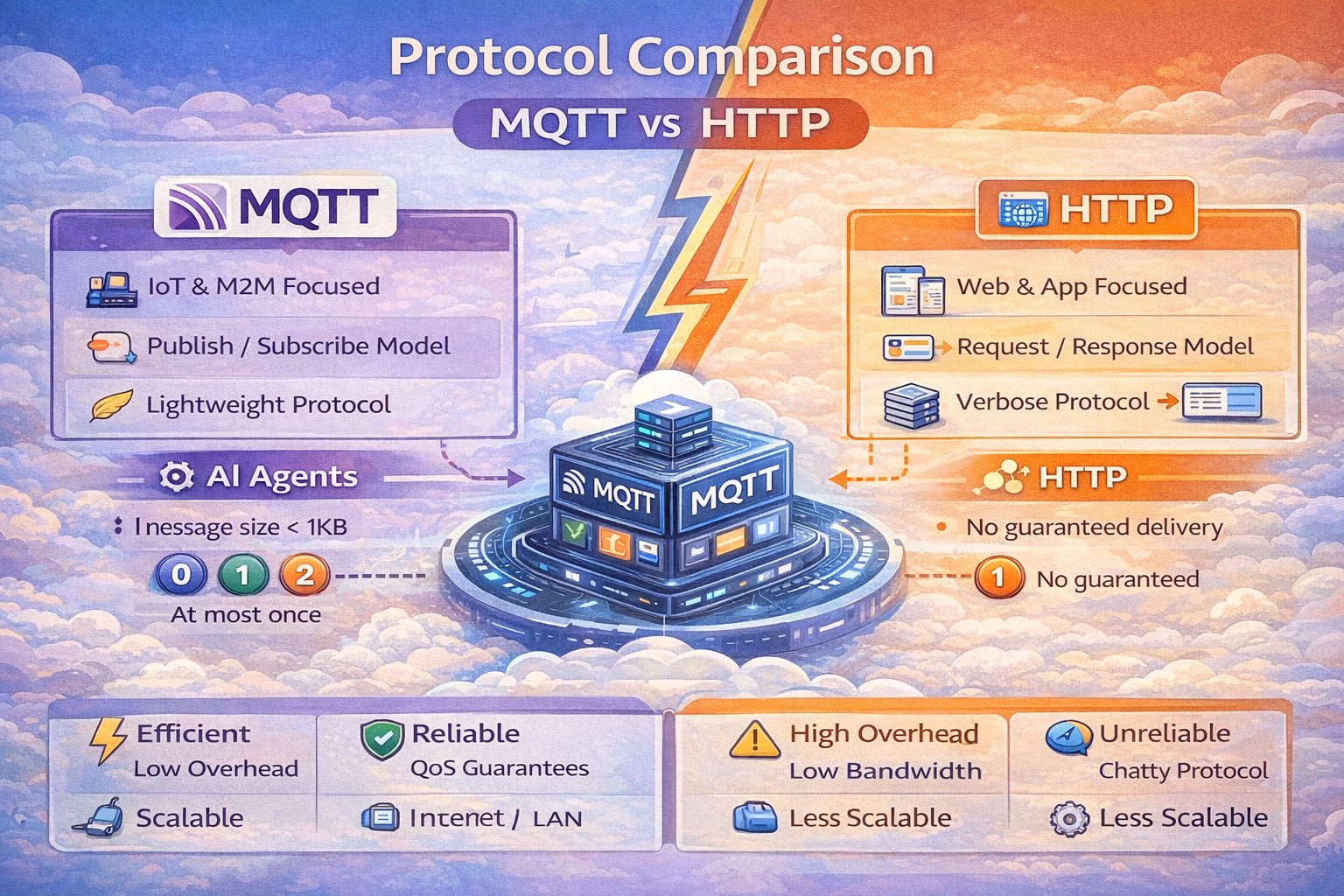
MQTT vs. HTTP: Choosing the Right Protocol for Your IoT Project
When designing an IoT system, one of the most fundamental decisions is choosing the right communication protocol. While HTTP is the backbone of the web, MQTT has emerged as the de facto standard for IoT. Understanding their core differences is key to building an efficient and scalable system. This article focuses specifically on the comparison with HTTP. For a complete, in-depth exploration of the protocol itself, from its architecture to advanced features, be sure to read our new Definitive Guide to the MQTT Protocol.
Architectural Differences
The most significant difference lies in their communication models.
HTTP: Request-Response
HTTP operates on a client-server, request-response model. A client sends a request to a server, and the server sends back a response. This is a one-to-one, synchronous interaction.
MQTT: Publish-Subscribe
MQTT uses a publish-subscribe (pub-sub) model, which is asynchronous and brokered. Clients connect to a central MQTT broker and can either publish messages to a "topic" or subscribe to a topic to receive messages.
Key Comparison Points
| Feature | HTTP | MQTT | Winner for IoT |
|---|---|---|---|
| Model | Request-Response | Publish-Subscribe | MQTT |
| Overhead | High (text-based headers) | Very Low (2-byte fixed header) | MQTT |
| Connection | Stateless (new connection per request) | Stateful (persistent TCP connection) | MQTT |
| Reliability | Relies on TCP | Built-in QoS levels (0, 1, 2) | MQTT |
Overhead and Power Consumption
HTTP headers are verbose. A simple POST request can have hundreds of bytes of header data, even if the payload is just a few bytes. For battery-powered devices sending frequent updates, like an ESP32 sensor, this directly impacts battery life.
MQTT, with its 2-byte header and persistent connection, is vastly more efficient. A device can remain in a low-power state and only wake when it needs to send or receive data, a core principle of efficient IoT design.
When is HTTP a Good Choice for IoT?
Despite MQTT's advantages, HTTP still has its place:
- Device-to-Cloud Data Ingestion: For devices that send infrequent, large batches of data, the overhead of a single HTTP POST is negligible.
- Firewall Traversal: HTTP uses standard web ports (80, 443) that are almost always open.
- Requesting Data: When a device needs to pull a specific file, like firmware or configuration, a simple HTTP GET is a direct solution.
Conclusion: For real-time, event-driven communication with resource-constrained devices, MQTT is the clear winner. HTTP should be reserved for specific, non-real-time tasks.
Deep Dive: A Feature-by-Feature Protocol Analysis
To truly appreciate why MQTT has become the standard for IoT messaging, we must move beyond a high-level overview and dissect the specific technical mechanics of each protocol. This detailed analysis will explore how their fundamental differences in design philosophy have profound impacts on real-world performance, reliability, power efficiency, and system scalability.
Anatomy of Overhead: A Quantitative Look
Let's quantify the term "overhead." Consider an IoT sensor that needs to send a simple JSON payload: {"temp":25.3}. This payload is 14 bytes.
HTTP/1.1 Request: A minimal HTTP POST request to send this data would look something like this:
POST /api/v1/data HTTP/1.1
Host: my-iot-server.com
Content-Type: application/json
Content-Length: 14
User-Agent: ESP32-Client/1.0

{"temp":25.3}
Even with this barebones example, the headers alone (POST...User-Agent) amount to ~120 bytes. The total data sent is 120 (headers) + 14 (payload) = 134 bytes. The overhead is 85% of the total packet size. In real-world scenarios with more headers (like Authorization for security), this can easily exceed 300-400 bytes.
MQTT Publish:
An MQTT PUBLISH packet is a binary structure. It consists of:
- Fixed Header (2 bytes): This is the mandatory starting point of every MQTT packet.
- Variable Header: Contains the topic name (e.g.,
device/123/temp). Let's say this is 15 bytes. - Payload (14 bytes): The
{"temp":25.3}data.
Total data sent is 2 (fixed header) + 15 (topic) + 14 (payload) = 31 bytes. The overhead here, represented by the MQTT-specific headers, is 54%. While still significant, this is a 77% reduction in total data sent compared to the minimal HTTP request. For smaller payloads (e.g., sending just the float value 25.3), the difference is even more stark.
This dramatic reduction in bandwidth usage is a primary reason why MQTT is the preferred protocol for cellular IoT, where every byte translates directly into data plan costs.
The Power Consumption Dilemma: Connection Management
For a battery-powered device, the radio is often the most power-hungry component. The cost of communication is not just in sending data but in establishing the ability to send data.
The HTTP Cycle:
- Wake Up: Device wakes from deep sleep.
- DNS Lookup: Resolve
my-iot-server.comto an IP address. (High energy cost) - TCP Handshake: The three-way
SYN/SYN-ACK/ACKto establish a TCP connection. (High energy cost) - TLS Handshake: If using HTTPS (which is mandatory for any secure application), a complex series of ~9-12 packets are exchanged to negotiate a secure session. This is by far the most energy-intensive part of the cycle.
- HTTP Request: Send the actual data.
- HTTP Response: Receive the
200 OKresponse. - TCP Teardown: Close the connection.
- Go to Sleep.
This entire cycle must be repeated for every single data point the device sends.
The MQTT Cycle: On First Connection:
- Wake Up: Device wakes.
- DNS Lookup: Resolve
my-mqtt-broker.comto an IP address. - TCP Handshake: Establish a TCP connection.
- TLS Handshake: Negotiate a secure session.
- MQTT Connect: Send a single
CONNECTpacket.
For Subsequent Communication:
- Wake Up: The device wakes from a light sleep state.
- MQTT Publish: Send the
PUBLISHpacket over the already established, persistent secure connection. - Go to Sleep.
MQTT eliminates the repeated DNS, TCP, and, most importantly, TLS handshake costs for every message. The connection is kept alive with tiny, infrequent PINGREQ/PINGRESP packets (2 bytes each), which are vastly more efficient than re-establishing the entire stack.
Analogy: The Phone Call
HTTP is like making a new phone call for every sentence you want to say. You have to dial the number, wait for it to ring, say "hello," say your sentence, say "goodbye," and hang up. Repeat for the next sentence.
MQTT is like making one phone call and keeping the line open. You say your sentence, wait, and then say the next one without ever hanging up. The energy saved from not redialing and reconnecting is immense.
Bidirectional Communication: The Inefficiency of Polling
The greatest architectural weakness of HTTP for real-time IoT is its client-initiated nature. A server cannot start a conversation with a client. This poses a major problem: How do you send a command from your application to your IoT device?
With HTTP, the only way is polling. The device must constantly ask the server, "Do you have a command for me?"
This model is profoundly inefficient:
- High Latency: The command is only received on the next polling interval. If the device polls every 5 minutes to save battery, there could be a 5-minute delay in its response.
- Wasted Battery & Bandwidth: 99.9% of the polling requests are wasted, returning no command but consuming the full energy and data cost of an HTTPS request-response cycle.
- Server Load: The server is bombarded with constant requests from thousands of devices, most of which require no action.
MQTT solves this natively. The publish-subscribe model is inherently bidirectional. A device subscribes to a command topic (e.g., device/123/commands) when it connects. It then sits idle. When your application wants to send a command, it simply publishes a message to that topic. The MQTT broker, maintaining the persistent connection to the device, instantly forwards the message.
This provides true real-time, push-based communication. It is dramatically more efficient, responsive, and scalable than HTTP polling.
Reliability & State Management: Beyond TCP
While HTTP runs over TCP, which guarantees that a single request, once sent, will arrive intact, it has no application-level concept of message delivery guarantees across sessions.
MQTT introduces two critical features that are purpose-built for unreliable networks:
-
Quality of Service (QoS): As discussed, these are application-level guarantees.
- QoS 1 (At Least Once): The broker confirms receipt of the message. If the device disconnects before getting the confirmation, it will resend upon reconnection. This ensures important commands or alerts are never lost due to a transient network blip.
- QoS 2 (Exactly Once): A four-part handshake that guarantees the message is processed only once, vital for critical operations like billing or irreversible commands.
-
Persistent Sessions & Offline Queuing: This is a killer feature for IoT. When a client subscribes with
cleanSession=false, the broker remembers its subscriptions. If the device disconnects, the broker will queue all QoS 1 and QoS 2 messages sent to its topics. When the device reconnects, the broker immediately delivers the backlog of messages. This ensures a device that was temporarily offline (e.g., a sensor in an area with spotty cellular coverage) will eventually receive all critical commands and updates it missed. HTTP has no equivalent mechanism. -
Last Will and Testament (LWT): Another ingenious IoT-centric feature. When an MQTT client connects, it can define an "LWT" message. If the client disconnects ungracefully (e.g., loses power, crashes), the broker will automatically publish this LWT message on its behalf. A common use is to publish a
{"status": "offline"}message to a device status topic. This allows the system to instantly and reliably detect when a device has gone offline, rather than waiting for a long timeout period.
Building Real-World Systems: The Hybrid Approach
While MQTT is superior for event-driven messaging, HTTP is the undisputed king of document retrieval. Mature IoT architectures don't choose one; they leverage both for their respective strengths.
A Common IoT Device Lifecycle:
-
Provisioning (HTTP): A brand new device comes online. It only knows one thing: the address of the provisioning server. It makes a secure HTTPS POST request to
https://provision.my-iot-server.com/register, sending its unique hardware ID.- The server validates the ID, creates a new entry in the database, generates credentials for the device, and associates it with a user account.
- The server's response to the HTTP request is a JSON payload containing the full configuration for the device:
{"mqtt_broker": "mqtts://broker.my-iot-server.com", "clientID": "device_789", "username": "...", "password": "..."}.
-
Real-Time Operation (MQTT): The device now has everything it needs. It disconnects the HTTP session and establishes a persistent, secure MQTT connection to the broker. From this point forward, all real-time telemetry and command-and-control happens over MQTT.
-
Over-the-Air (OTA) Firmware Updates (MQTT + HTTP):
- The central server determines a new firmware version is available for the device.
- It publishes an MQTT message to the device's command topic:
device/789/commandswith a payload like{"action": "FIRMWARE_UPDATE", "url": "https://updates.my-iot-server.com/v2.1/firmware.bin"}. - The device receives this MQTT message instantly.
- It then opens a new, temporary HTTPS client, makes a single GET request to the provided URL to download the binary file, verifies the file's integrity, and performs the update.
- During this process, it can continue to send and receive critical MQTT messages.
This hybrid model provides a robust, secure, and efficient framework, using the right tool for the right job.
A Glimpse into the Future: HTTP/2, HTTP/3, and CoAP
It's worth noting that HTTP is not standing still. Newer versions address some of its limitations:
- HTTP/2: Introduces multiplexing, allowing multiple requests and responses over a single TCP connection, which reduces the connection overhead.
- HTTP/3: Runs over QUIC (a UDP-based transport), which further speeds up connection establishment.
However, even with these improvements, they do not change the fundamental request-response paradigm. They don't add features like Quality of Service, Last Will and Testament, or persistent session queuing. They also don't change the verbose, text-based nature of the headers. Therefore, while they make HTTP better, they don't transform it into a publish-subscribe protocol purpose-built for IoT.
CoAP (Constrained Application Protocol) is another relevant protocol. Designed by the IETF, it is a lightweight, UDP-based protocol that mimics the request-response model of HTTP but with a much smaller binary header. It's an excellent choice for highly constrained, local-area networks but lacks the brokered, one-to-many architecture of MQTT that makes scaling large, distributed systems easier.
In the vast landscape of IoT protocols, MQTT has carved out its dominant position by providing the most effective, efficient, and scalable solution for the core challenge of event-driven, bidirectional communication between devices and the cloud.