What is MQTT Protocol? A Detailed Explanation
March 15, 2026
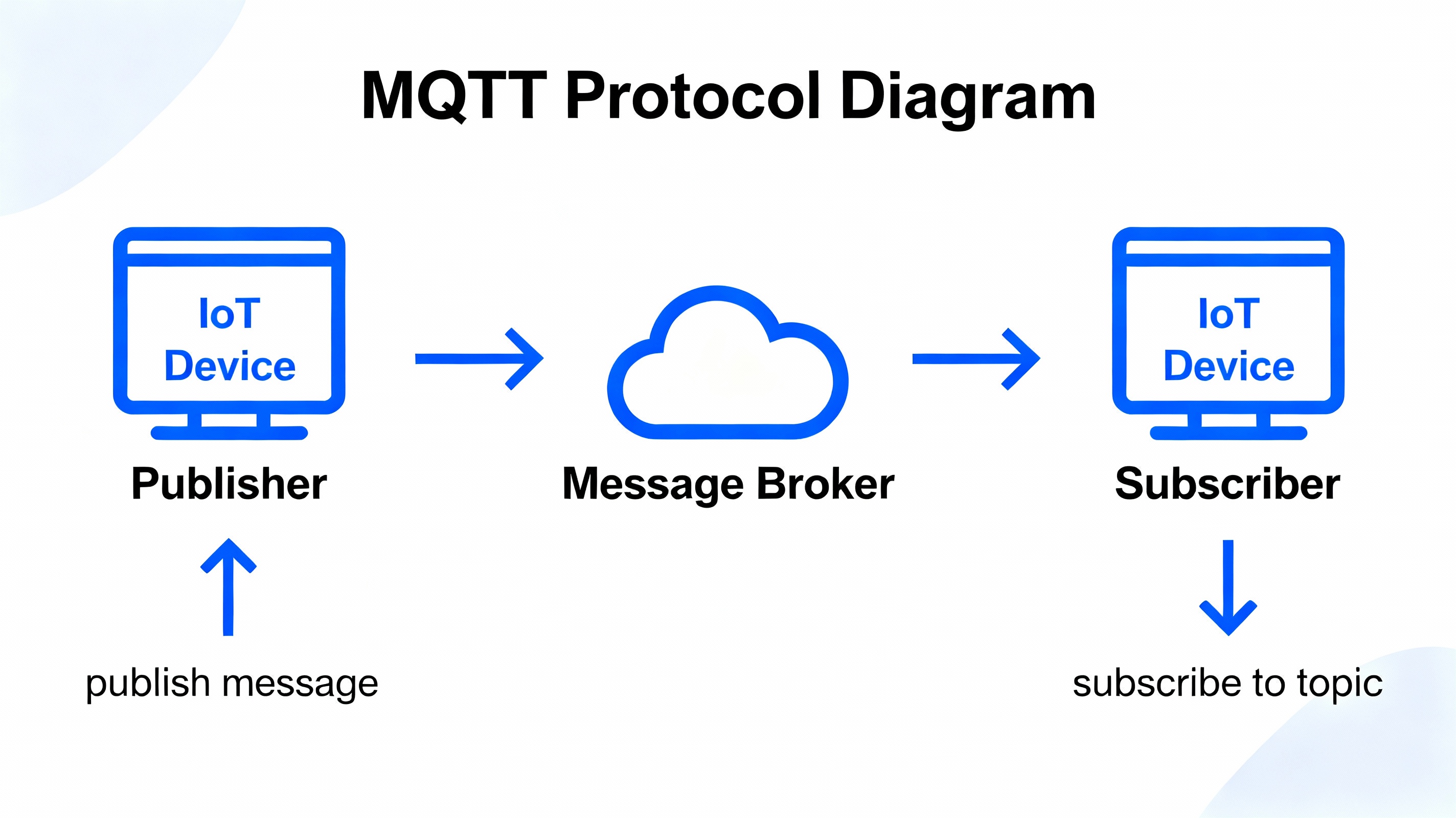
What is MQTT Protocol? A Detailed Explanation
MQTT, or Message Queuing Telemetry Transport, is a lightweight messaging protocol designed for efficient communication between devices, particularly in environments with constrained resources and unreliable networks. It has become the dominant standard for the Internet of Things (IoT) due to its simplicity, low power consumption, and efficient use of bandwidth.
The protocol operates on a publish-subscribe (pub-sub) model, which distinguishes it from the common request-response architecture of the web (HTTP). This fundamental difference is what makes the MQTT protocol exceptionally suited for the asynchronous, event-driven world of connected devices. This article explains the core mechanics of the protocol. For an even more exhaustive resource covering advanced topics, security, and implementation at scale, see our new Definitive Guide to the MQTT Protocol.
The Core Components: Broker, Client, and Topic
The MQTT architecture consists of three main components:
- MQTT Broker: The central server that acts as a message post office. It receives all messages, filters them, and distributes them to the appropriate clients. The broker is responsible for managing client connections and subscriptions. A modern, enterprise-grade broker like the Synapse MQTT broker is a highly sophisticated piece of software designed for massive scale and reliability.
- MQTT Client: Any device or application that connects to the broker. A client can be a publisher (sends messages), a subscriber (receives messages), or both. This could be anything from a tiny sensor to a large-scale MQTT dashboard.
- Topic: A string that acts as a virtual channel or an address for messages. Topics are structured hierarchically using forward slashes, much like a file system path (e.g.,
factory/floor1/machineA/temperature).
How the Publish-Subscribe Model Works
In the pub-sub model, clients are decoupled, meaning they do not communicate directly with each other.
- Decoupling: A temperature sensor (a publisher) doesn't need to know the IP address or location of the dashboard (a subscriber) that displays its data. It simply sends its reading to the broker on a specific topic. This is a core concept we explore in our guide to the MQTT publish-subscribe model.
- Filtering: The broker maintains a list of all client subscriptions. When it receives a message on a topic, it forwards that message only to the clients that have subscribed to that exact topic or a matching wildcard pattern.
- Asynchronous Communication: Publishers can send messages and continue with their tasks without waiting for a response. Subscribers receive messages as they arrive, making the system event-driven and highly responsive.
Anatomy of an MQTT Packet
To truly understand the efficiency of the MQTT protocol, we must look at its structure. Every MQTT message is called a "Control Packet," and each packet consists of up to three parts:
-
Fixed Header (2 bytes): Present in every MQTT packet. This is the source of MQTT's legendary efficiency.
- Control Packet Type (4 bits): Defines the type of message (e.g.,
CONNECT,PUBLISH,SUBSCRIBE). - Flags (4 bits): Specific flags for certain packet types, like the
DUP(duplicate) flag for QoS > 0, theQoSlevel itself, and theRETAINflag forPUBLISHpackets. - Remaining Length (1-4 bytes): A variable-length integer that specifies the size of the rest of the packet. This clever encoding means small packets remain incredibly small.
- Control Packet Type (4 bits): Defines the type of message (e.g.,
-
Variable Header: Present in some packets. It contains additional information specific to the packet type, such as the Packet Identifier for messages with QoS > 0.
-
Payload: The actual content being transported. For a
PUBLISHpacket, this is your data (e.g., a JSON string, a binary image, or an XML blob). ForSUBSCRIBEpackets, it's the list of topic filters the client wants to subscribe to. The payload can be up to 256 MB, but in practice, it is usually much smaller.
Deep Dive into MQTT Control Packets (Commands)
The MQTT protocol defines 14 different types of Control Packets that govern the entire communication flow. Let's explore the most important ones.
CONNECT & CONNACK
The CONNECT packet is the first one a client sends after establishing a TCP connection. It initiates the session with the broker.
- Key Fields:
ClientId: A unique identifier for the client. A broker uses this to manage the client's session.Clean Session(orClean Startin MQTT 5): A critical flag. Iffalse, the broker will store the client's subscriptions and any missed QoS 1/2 messages while it was disconnected.Keep Alive: A time interval in seconds. If the broker receives no communication from the client within this period, it will consider the client disconnected.Last Will and Testament (LWT): A message (topic, payload, QoS, retain flag) that the client asks the broker to publish on its behalf if it disconnects ungracefully.
The broker responds with a CONNACK packet, which contains a return code indicating if the connection was successful.
PUBLISH
The workhorse of the MQTT protocol. This packet sends a message from a publisher to the broker.
- Flow:
- A client constructs a
PUBLISHpacket containing the topic name, the payload, a QoS level, and a retain flag. - For QoS 1 or 2, it also includes a unique Packet Identifier in the variable header.
- It sends the packet to the broker.
- The broker receives the packet, reads the topic, and forwards the message to all clients subscribed to that topic.
- A client constructs a
A powerful IIoT dashboard like MQTTfy is both a publisher and a subscriber. It publishes command messages (e.g., to turn a machine off) and subscribes to data topics to visualize real-time status.
SUBSCRIBE & SUBACK
This packet allows a client to register its interest in one or more topics. The payload contains a list of topic filters, each with a requested QoS level.
The broker responds with a SUBACK packet, which confirms the subscription and returns the QoS level granted by the broker for each topic filter. A broker may downgrade the QoS level based on its own policies.
QoS Handshakes: The Reliability Engine
Understanding the packet flows for Quality of Service is key to understanding MQTT's reliability.
-
QoS 1 (At Least Once):
sequenceDiagram Publisher->>Broker: PUBLISH (Packet ID: 123) Broker->>Publisher: PUBACK (Packet ID: 123)The publisher sends the
PUBLISHpacket and waits for aPUBACKfrom the broker. If it doesn't receive aPUBACKwithin a certain time, it re-sends thePUBLISHpacket with theDUPflag set to true. -
QoS 2 (Exactly Once):
sequenceDiagram Publisher->>Broker: PUBLISH (Packet ID: 456) Broker->>Publisher: PUBREC (Packet ID: 456) Publisher->>Broker: PUBREL (Packet ID: 456) Broker->>Publisher: PUBCOMP (Packet ID: 456)This four-part handshake ensures the message is delivered exactly once, eliminating duplicates. It's essential for critical operations like financial transactions or remote control in SCADA systems, but it has the highest overhead.
-
For a more detailed look at these flows, see our guide: MQTT QoS Explained (0, 1, & 2).
PINGREQ & PINGRESP
This is the keep-alive mechanism. If a client has not sent any other packets within its Keep Alive interval, it sends a tiny PINGREQ packet. The broker responds with a PINGRESP. This assures both sides that the other is still online and the network connection is valid.
MQTT Topic Structure and Wildcards
Topics are case-sensitive UTF-8 strings that create a hierarchy. For example: usa/new-york/office1/light/status
This structure allows for powerful filtering using two wildcard characters in subscriptions:
- Single-Level Wildcard (
+): Matches a single level in the hierarchy.usa/+/office1/#: Matches any office in any state in the USA.
- Multi-Level Wildcard (
#): Matches any number of levels from that point downward. It must be the last character.usa/new-york/#: Matches everything within the New York location.
This flexibility allows a single client to subscribe to data from thousands of devices with a single, simple subscription pattern. For example, a single MQTTfy dashboard widget could subscribe to factories/+/press-machine-*/temperature to monitor the temperature of all press machines across all factories.
Why the MQTT Protocol Dominates IoT
The design choices of the MQTT protocol directly address the core challenges of IoT:
| Feature | Explanation | Impact on IoT |
|---|---|---|
| Lightweight Header | MQTT messages have a minimal 2-byte header, reducing data overhead. | Essential for battery-powered IoT devices and networks with limited bandwidth like LoRaWAN or NB-IoT. |
| Persistent Connections | Clients maintain a long-lived TCP connection with the broker. | Reduces the power and overhead associated with repeatedly establishing new connections, a major drawback of HTTP for IoT. |
| Quality of Service (QoS) | Defines three levels of delivery guarantee: QoS 0, QoS 1, and QoS 2. | Allows developers to balance reliability against performance, using higher QoS for critical commands and lower QoS for routine sensor data. |
| Retained Messages | The broker can store the last known good message for a topic. New subscribers instantly receive this message upon connecting. | Provides immediate state information to newly connected clients, like a real-time dashboard, without waiting for the publisher to send a new update. |
| Last Will and Testament (LWT) | A message pre-registered with the broker that is automatically published if a client disconnects unexpectedly. | A reliable mechanism for device presence detection, crucial for securing and monitoring IoT devices. |
MQTT Protocol in Practice: From Hobbyist to Enterprise
Understanding the protocol is the first step. Implementing it effectively is the next. For small projects, setting up a Raspberry Pi as an MQTT broker is a fantastic way to learn. But for commercial or industrial applications, the demands are far greater.
An enterprise-grade platform like MQTTfy is built to handle the complexities of the MQTT protocol at scale. It provides:
- A Managed Broker: You don't need to worry about the low-level details of clustering, failover, and scaling. The Synapse MQTT broker provides this as a managed service.
- Effortless Visualization: An advanced MQTT dashboard abstracts the
SUBSCRIBEcommands and data parsing into a simple, drag-and-drop interface, making the data accessible to everyone, not just developers. - Simplified Security: It handles TLS termination, certificate management, and dynamic authorization, making it easy to enforce a robust security posture without becoming a protocol expert.
In conclusion, MQTT's lightweight design, efficient pub-sub model, and features for handling unreliable networks make it the ideal protocol for building scalable, responsive, and resilient IoT systems.