Case Study: Smart Aquaculture Monitoring Using MQTTfy Dashboard
February 22, 2026
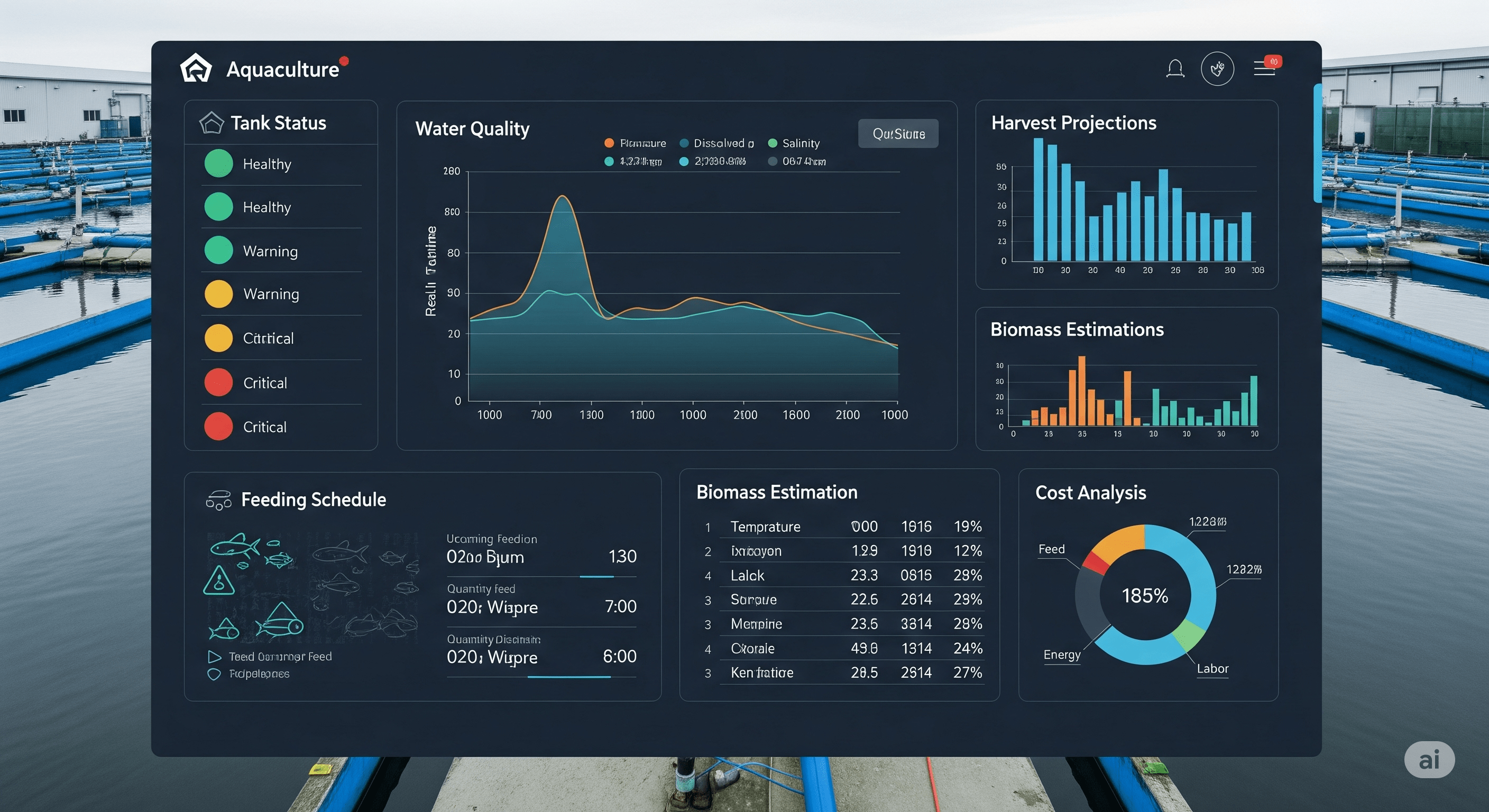
Aquaculture is rapidly becoming one of the most important food production industries in the world. With increasing global demand for seafood and declining wild fish populations, fish farming operations must become smarter, more efficient, and environmentally sustainable. Traditional aquaculture management methods rely heavily on manual observation, which often leads to delayed decision-making and costly losses. This is a specialized form of environmental monitoring that requires a robust MQTT Dashboard.
This case study explores how an advanced IoT-based aquaculture monitoring system powered by MQTTfy Dashboard helped a mid-scale fish farm reduce mortality rates, optimize water quality, automate feeding cycles, and improve operational efficiency using real-time data analytics and MQTT communication.
The Challenge: Managing Water Quality at Scale
A 40-acre inland fish farm operating multiple ponds faced serious challenges:
- Sudden fish mortality due to oxygen fluctuations
- Inconsistent water temperature across ponds
- Manual pH testing once daily
- Overfeeding leading to water contamination
- No centralized monitoring system
- Lack of historical analytics
The farm relied on manual data logging and visual inspection. By the time abnormal water parameters were noticed, damage was already done.
The management team needed:
- Real-time aquaculture monitoring
- Automated alerts
- Remote access to pond conditions
- Historical data analytics
- Scalable IoT architecture
- Low network bandwidth solution
Why MQTT-Based IoT for Aquaculture?
Fish farms are often located in remote areas with:
- Limited internet connectivity
- Cellular data networks
- Power fluctuations
- Harsh environmental conditions
Traditional cloud-heavy systems fail in such environments.
MQTT-based IoT architecture offers:
- Lightweight communication
- Low bandwidth usage
- Reliable message delivery
- Offline buffering
- Scalable device connectivity
By using an MQTTfy Dashboard, the farm could connect distributed sensors across ponds to a centralized real-time IoT monitoring interface.
System Architecture Overview
The deployed system followed a layered IoT design:
Each pond was equipped with:
- Dissolved Oxygen (DO) sensor
- Water temperature sensor
- pH sensor
- Turbidity sensor
- Automatic feeder controller
- Water aerator control relay
These sensors were connected to a Raspberry Pi-based edge gateway, a setup detailed in our Raspberry Pi camera tutorial.
MQTT Communication Layer
The edge gateway:
- Collected sensor readings every 10 seconds
- Packaged readings into JSON payloads
- Published data to MQTT broker
- Subscribed to control commands
| Topic | Direction | Purpose |
|---|---|---|
aquafarm/pond1/oxygen | Inbound | Publishes a full JSON object with all water quality readings from the probe in Tank 7. |
aquafarm/pond1/ph | Inbound | The aerator controller reports its current operational status (e.g., "ON", "OFF", "FAULT"). |
aquafarm/pond1/temperature | Outbound | Send a command from the dashboard to turn the aerator ON or OFF. |
aquafarm/pond1/feeder/control | Outbound | Send a command to trigger a feeding cycle. |
farm/system/oxygen_generator/state | Inbound | The main oxygen generator for the entire farm reports its status and pressure. |
Cloud Layer (MQTTfy Dashboard)
The MQTTfy Dashboard provided:
- Real-time aquaculture monitoring
- Alert system
- Historical charts
- Role-based access control
- Multi-pond visualization
- Automated rule engine
Implementation Details
Sensor Data Format
Each MQTT message contained structured JSON:
{
  "timestamp": 1700000000,
  "oxygen": 6.5,
  "temperature": 28.4,
  "ph": 7.2,
  "turbidity": 15
}
This allowed the dashboard to extract values using data paths and display them in dynamic widgets.
Dashboard Design Strategy
The MQTTfy aquaculture dashboard was designed with clarity and actionability in mind. A core principle was building an effective IoT dashboard from the start.
Primary Widgets Per Pond
- Live oxygen gauge
- Temperature trend graph
- pH value indicator
- Turbidity line chart
- Aerator status indicator
- Feeding activity log
Global Overview Panel
- Average oxygen across all ponds
- High-risk pond alerts
- Feed consumption summary
- Energy usage tracking, similar to our energy management case study.
This layered design allowed operators to quickly identify anomalies across large-scale operations.
Real-Time Alerts and Automation
One of the biggest improvements came from automated threshold-based alerts.
Alert Conditions Configured
- Oxygen < 5.5 mg/L → Trigger aerator
- pH < 6.5 or > 8.5 → Send alert
- Temperature > 32°C → Notify operator
- Turbidity spike → Flag inspection
The MQTTfy rule engine automatically:
- Detected threshold breach
- Published control command
- Activated aeration system
- Logged event in dashboard
This eliminated manual intervention delays.
Results Achieved
After 6 months of deployment, measurable improvements were recorded.
- Reduced Fish Mortality by 32%: Early oxygen detection prevented nighttime oxygen crashes.
- Feed Efficiency Improved by 18%: Automated feeding schedules reduced overfeeding.
- Water Quality Stability Increased: Continuous pH and temperature monitoring allowed rapid correction.
- Labor Costs Reduced by 22%: Remote dashboard monitoring reduced manual inspection trips.
- Data-Driven Decision Making: Historical analytics identified seasonal trends affecting pond health.
Advanced Analytics Insights
The farm began leveraging historical IoT data for predictive insights. Effective data visualization was key to this process.
Trend Analysis Identified:
- Oxygen drops between 2 AM–4 AM
- pH instability during heavy rainfall
- Higher turbidity after excessive feeding
Using MQTTfy analytics dashboards, management optimized:
- Feeding times
- Aeration schedules
- Water replacement cycles
Scalability Strategy
After initial success, the farm expanded from 8 ponds to 20 ponds, similar to the scaling challenges in smart city deployments.
MQTTfy handled scaling without performance issues due to:
- Lightweight MQTT messaging
- Efficient topic hierarchy
- Broker clustering
- Optimized dashboard widgets
The architecture was future-ready for:
- AI integration
- Machine learning models
- Predictive fish health monitoring
- Multi-farm centralized management
Security Implementation
Since aquaculture is a revenue-critical operation, security was prioritized.
Measures implemented:
- TLS encrypted MQTT communication
- Unique device authentication tokens
- Topic-level access control
- Role-based dashboard permissions
- Regular credential rotation
This ensured data integrity and prevented unauthorized device control.
Bandwidth Optimization for Remote Farms
Since the farm used 4G connectivity:
- Sensor data was sent every 10 seconds
- Control commands were lightweight
- No heavy video streaming
- Payload compression implemented
Average daily data usage remained under 200 MB for 20 ponds.
Why MQTTfy Was Critical to Success
Compared to generic IoT dashboards, the MQTTfy Dashboard provided:
- Native MQTT topic handling
- Flexible JSON parsing
- Easy widget customization
- Real-time data visualization
- Reliable cloud architecture
- Simple automation rules
The ability to configure dashboards without complex backend coding accelerated deployment.
Future Roadmap
The farm plans to integrate:
- AI-Based Disease Detection: Using water quality anomalies as early warning signals.
- Weather API Integration: Predict rainfall impact on pH levels.
- Camera-Based Fish Activity Monitoring: Integrated into an MQTTfy Dashboard using camera widgets.
- Centralized Multi-Location Dashboard: Manage multiple farms from one control center, much like in industrial monitoring.
Business Impact
The deployment demonstrated that IoT in aquaculture is not just technology adoption — it is a profitability multiplier.
Return on investment was achieved within 11 months due to:
- Reduced mortality
- Optimized feed usage
- Lower labor costs
- Improved yield consistency
The farm is now exploring licensing its monitoring model to neighboring farms.
Conclusion
This aquaculture IoT case study demonstrates how an MQTTfy Dashboard can transform traditional fish farming into a data-driven, automated, and highly efficient operation.
By combining:
- Edge sensors
- MQTT communication
- Real-time dashboards
- Automated rule engines
- Historical analytics
The farm achieved measurable improvements in productivity, sustainability, and profitability.
Smart aquaculture monitoring is no longer a luxury — it is becoming essential for modern fish farming operations, a specific application of smart farming principles.
With MQTTfy, aquaculture operators gain:
- Full visibility
- Intelligent automation
- Scalable IoT infrastructure
- Remote control capabilities
- Actionable data insights
As global food demand rises, IoT-powered aquaculture systems will define the future of sustainable seafood production.
Frequently Asked Questions
What is Dissolved Oxygen (DO) and why is it critical in aquaculture?
Dissolved Oxygen is the amount of gaseous oxygen dissolved in the water. Fish breathe this oxygen through their gills. High stock densities in modern aquaculture consume DO very quickly. If the DO level falls below a critical threshold (typically 4-5 mg/L), fish become stressed and can die within hours, making continuous DO monitoring the single most important task in fish farming.
What is a Recirculating Aquaculture System (RAS)?
A RAS is a highly controlled, land-based fish farming method where water is treated and reused rather than being discharged. It typically consists of fish tanks, mechanical filters (to remove solids), and biological filters (to convert toxic ammonia from fish waste into harmless nitrates). RAS allows for high-density production with minimal water usage but requires precise process control, making it ideal for IoT monitoring.
How can you automate fish feeding with MQTT?
Automated feeders can be controlled via MQTT. You can have a central controller or dashboard publish a command to an MQTT topic like 'farm/tank-3/feeder/set'. A device on the feeder, subscribed to this topic, receives the command ('ON') and activates a motor to dispense a pre-set amount of feed. This allows for precise, scheduled feeding without manual labor.
What is the purpose of monitoring both state and command topics?
It creates a 'digital twin' of your device. You send a command to a 'set' topic (e.g., '.../pump/set' -> 'ON'). The pump turns on and then confirms its new status by publishing to a 'state' topic ('.../pump/state' -> 'ON'). Your dashboard should display the 'state' topic. If you send a command and the state doesn't change, you know there is a problem with the equipment, providing critical feedback.
Why is real-time alerting so important in aquaculture?
Conditions in a high-density fish tank can change with alarming speed. A pump failure can cause a catastrophic drop in Dissolved Oxygen in under an hour. A real-time dashboard with automated alerting (via SMS, email, or visual alarms) is not just a convenience; it's an essential insurance policy against losing an entire tank of stock, which could be worth thousands of dollars.